Before your session
How to prepare for your flying dress photoshoot in Rome
Everything you need to know before you show up: how the session runs, what to put in your bag, and the poses we shoot. Five minutes to read, once.
How it works
Your session, step by step
-
Where we meet
We send you the exact spot in advance. Arrive 15 minutes before your time — those minutes are the difference between a calm session and a rushed one.
-
You change at the meeting point
The flying dress is included and we bring it with us. You change on location, in private, before we start — you'll find the options just below.
-
Dedicated time in front of the camera
The photographer guides you through every pose: you don't need to know what to do, and you don't need any modeling experience. An assistant throws and arranges the train for every single shot.
-
Wide frames, shot from a distance
We shoot from a distance: the monument and the train are the subject. This isn't a close-up portrait, it's a scene.
Where you get changed
In the car — the option we recommend
At the meeting point. The car is roomy and has dark privacy glass. It's also the fastest: there is nothing to set up, and the dress never touches the ground before we have even started shooting.
If you'd rather change standing up
We set up a pop-up changing cabin on location. It takes a few extra minutes and leaves the dress more exposed.
At your hotel — €50 supplement
Possible only when the logistics allow it and it doesn't add too much travel: it depends on the location you choose and where you're staying. Ask us when you book.
Whichever you choose, our assistant helps you: once the dress is on she ties it at the shoulders or neck and arranges everything before we start.
What to bring
What to bring and what to wear
Six things. None of them complicated, all of them worth doing.
-
Hair and makeup done before you arrive
Come ready from home or from your hotel. There is no time to get ready on location.
-
Nude, strapless underwear
The dress is corseted: straps show up in every single frame.
-
Elegant shoes that go with the dress
The frames are often full-length, so your feet do show. The choice is yours — the only thing that matters is that they work with the red.
-
No statement necklaces
They compete with the dress and pull the eye away from where it should be.
-
A bottle of water
Even early in the morning you'll want it. Nothing is open near the monuments.
-
Fifteen minutes early
The one genuinely strict rule of the day.
The poses
The poses we shoot
No two sessions are the same. If you let go we lean into the movement — the run, the turn, the walk; if you'd rather keep things controlled we work on the still poses. We decide on location, based on your personality and how you're feeling. Nothing to memorize: the photographer walks you through each one.
Solo session
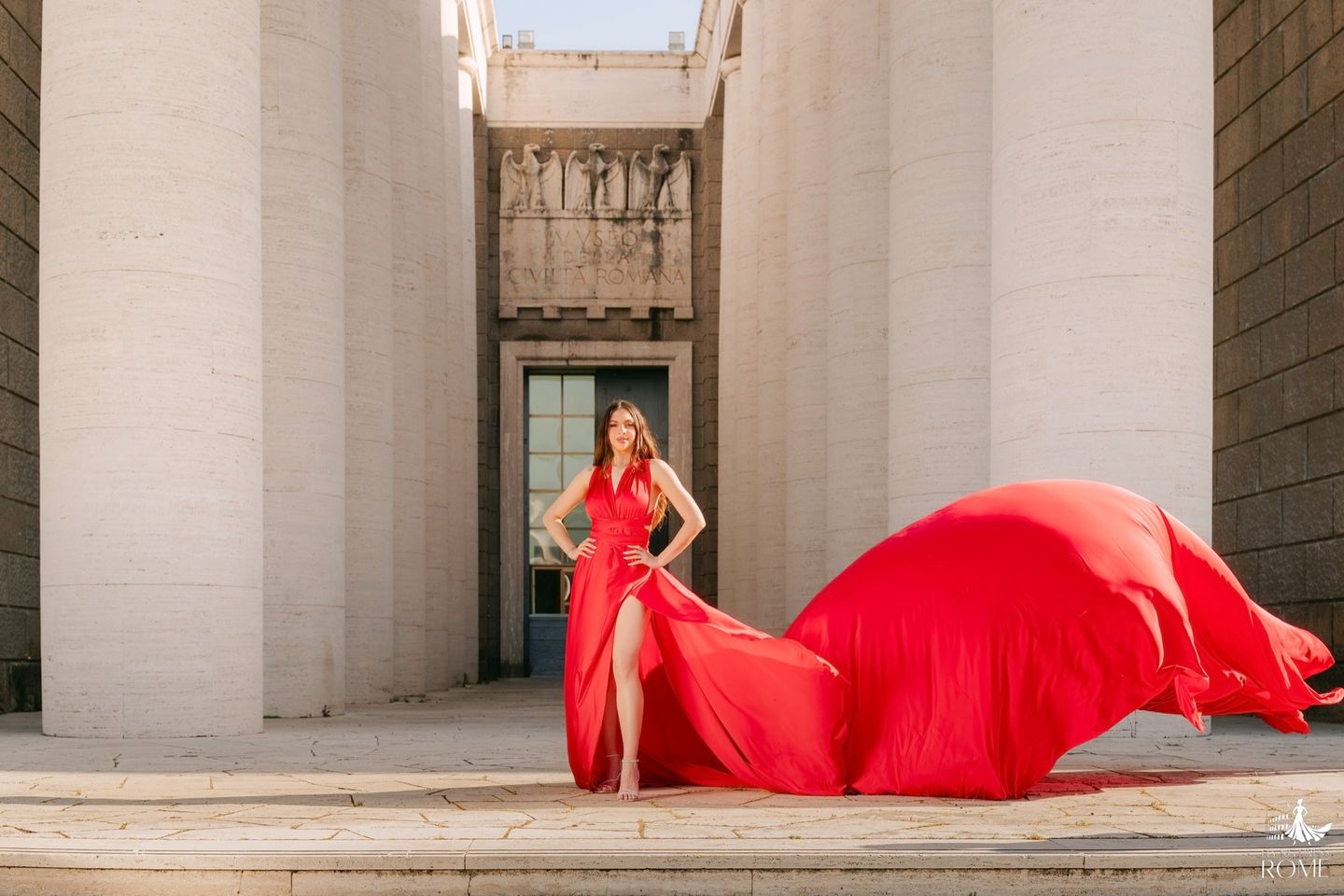
The Reveal
Facing the camera, chin up, hands on your hips: the dress and all five meters of train are in full view. It's the first frame we shoot — the one where you realize what you're wearing.
You: Look straight into the lens and hold still. We take care of the rest.
We: We open the train out and arrange it so all of it fits in the frame.
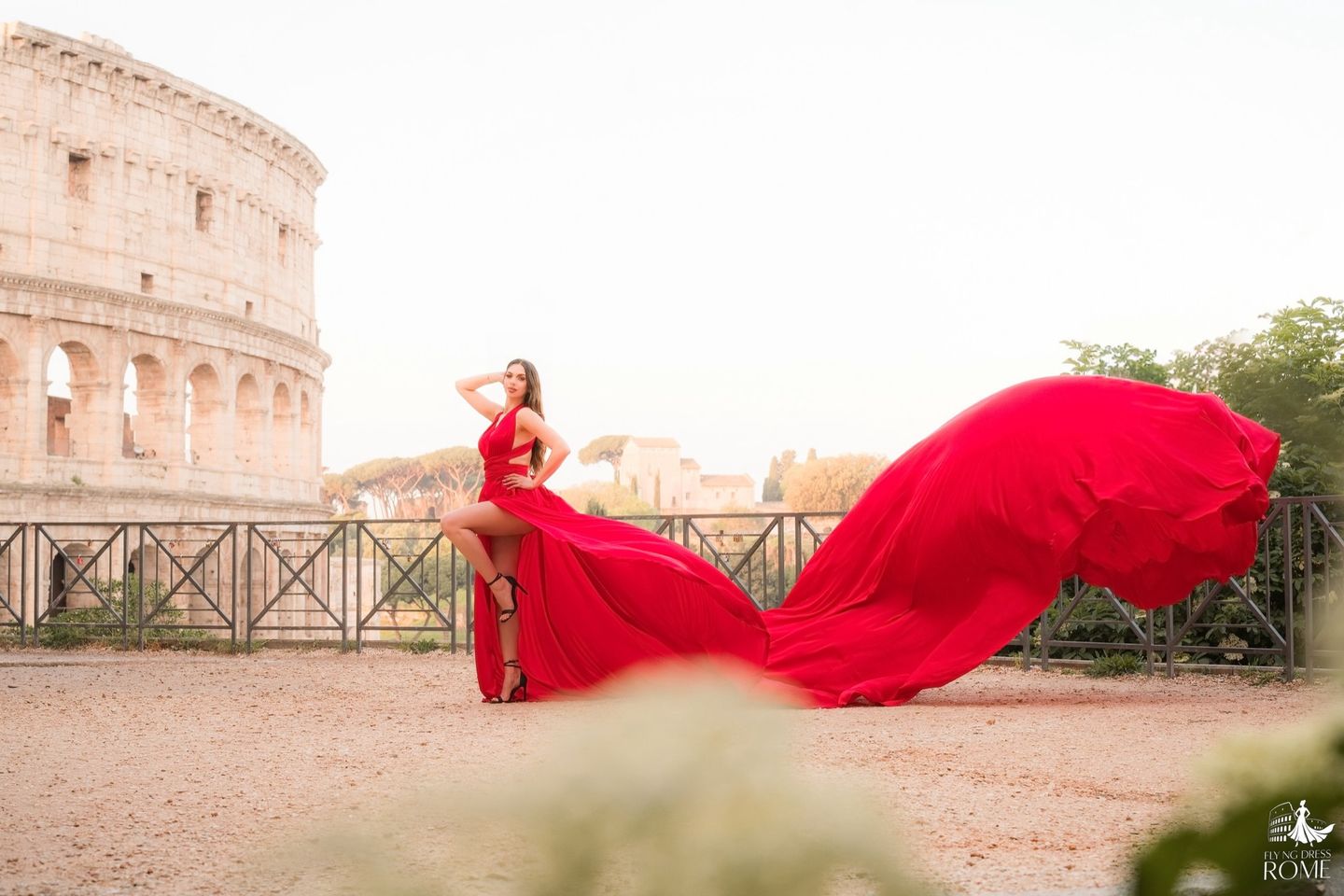
The Icon
One hand in your hair, weight on one leg, the train drawing an arc behind you. This is the photo people picture when they say "flying dress".
You: Shift your weight onto one leg and bring a hand up to your hair. Everything else stays still.
We: We throw the train out to the side and shoot while the arc is still open.
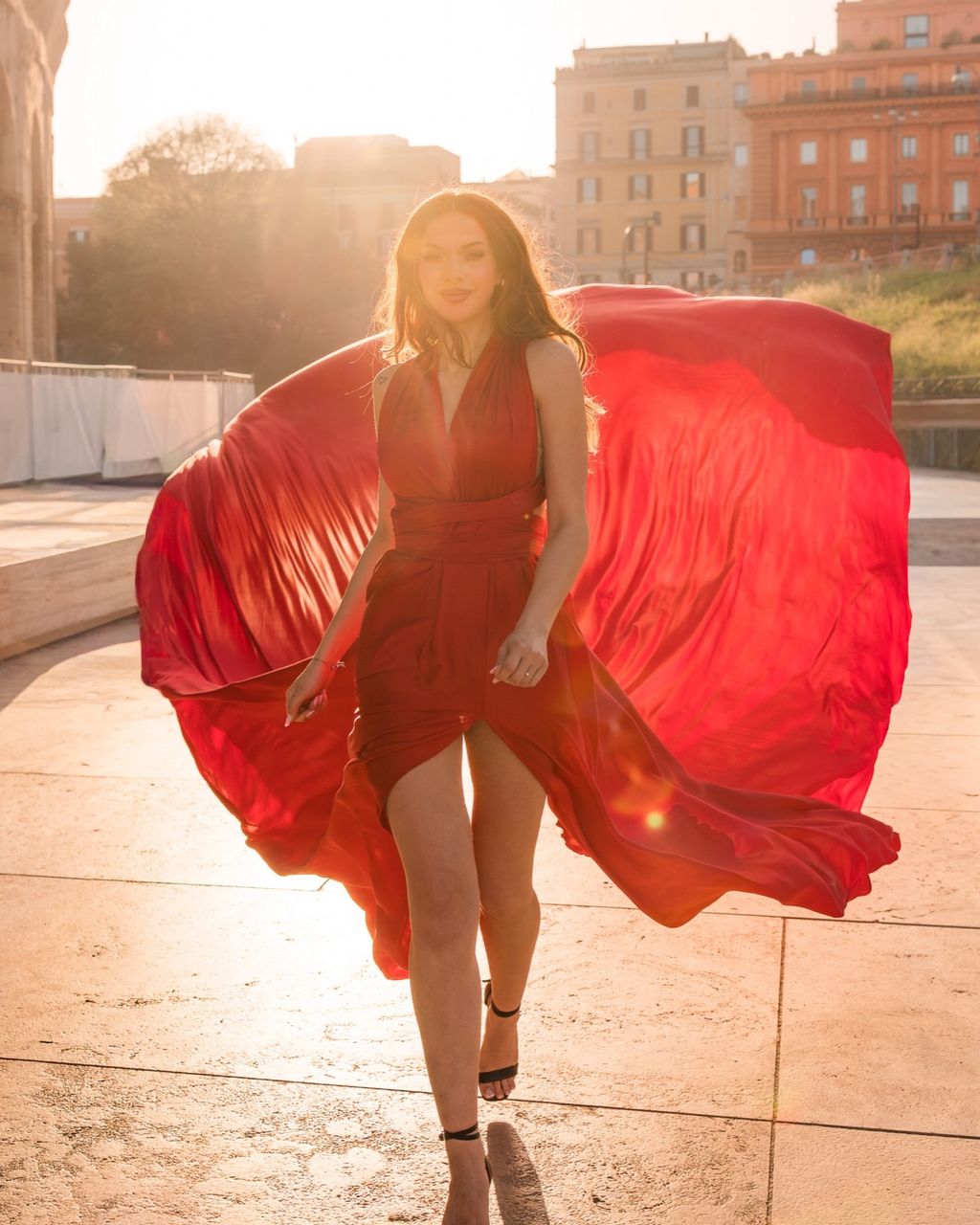
The Walk
A slow walk with the low sun in front of you: the train opens at your sides and the light passes straight through it. There's nothing to act out here — the movement does the work.
You: Walk slowly, looking ahead. You don't have to put on a face.
We: We shoot into the light and keep the train open as you come forward.
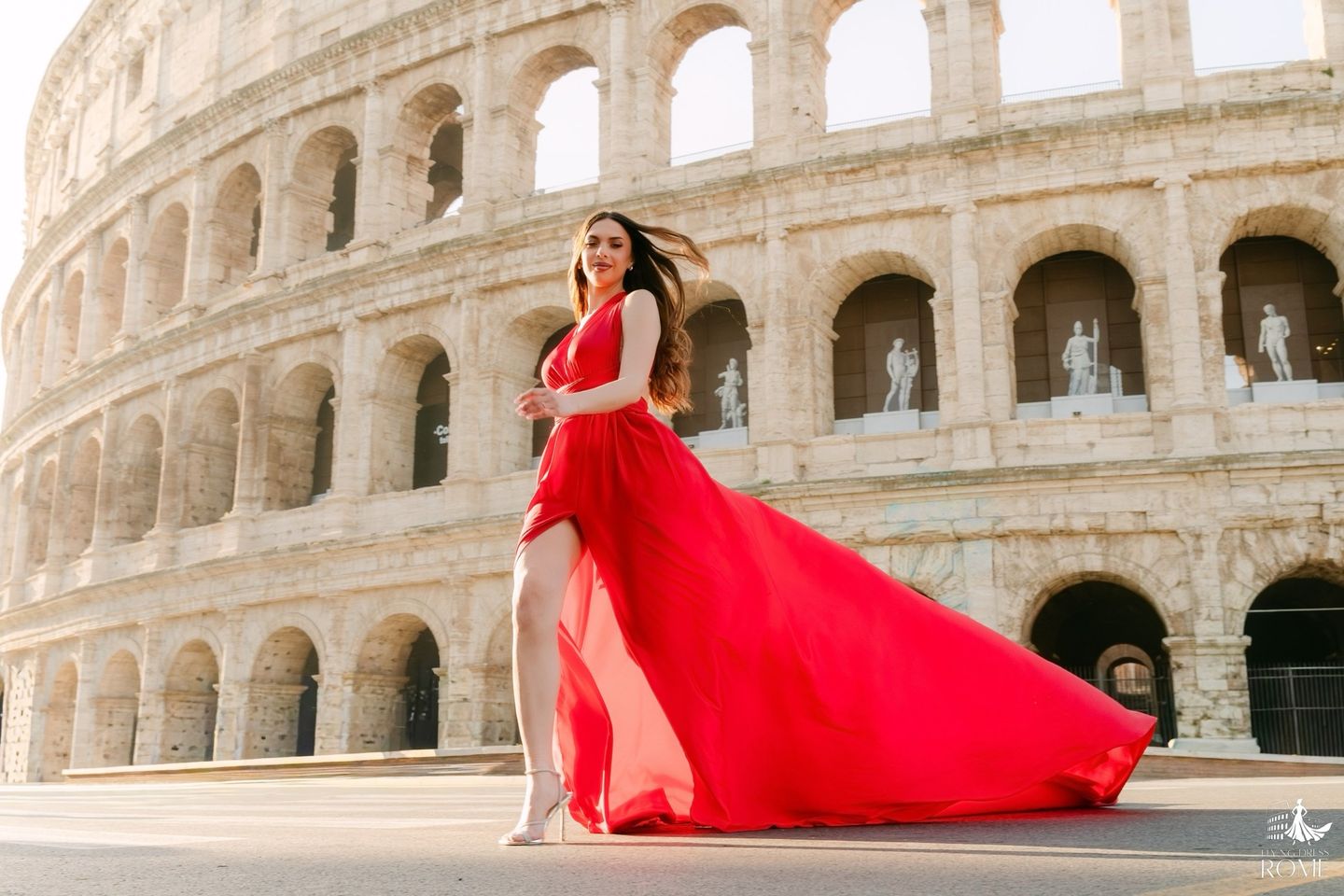
The Run
A light run, just a few steps: your hair follows, the skirt wraps around your legs and everything moves at once. We do it several times — the good frame lives inside a split second.
You: Run gently for a few meters, then stop. Then again.
We: We shoot in bursts and tell you the moment we have it.
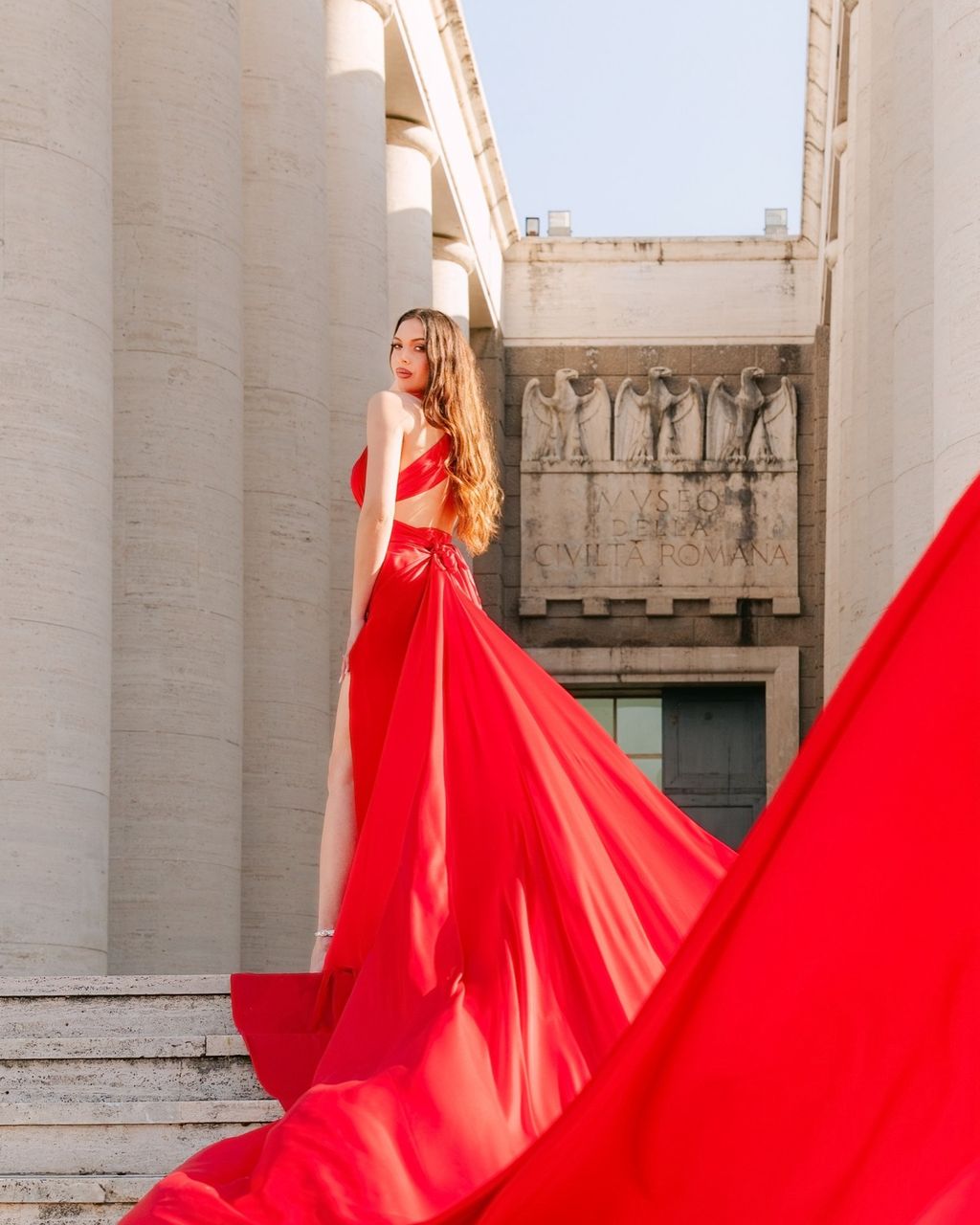
The Twirl
One turn on the spot: as you rotate, your eyes come back over your shoulder and the train follows you into the air. This is the pose that gives the feeling of flight.
You: Turn slowly and let your eyes finish the movement.
We: We throw the train just before you turn, so it catches up with you mid-rotation.
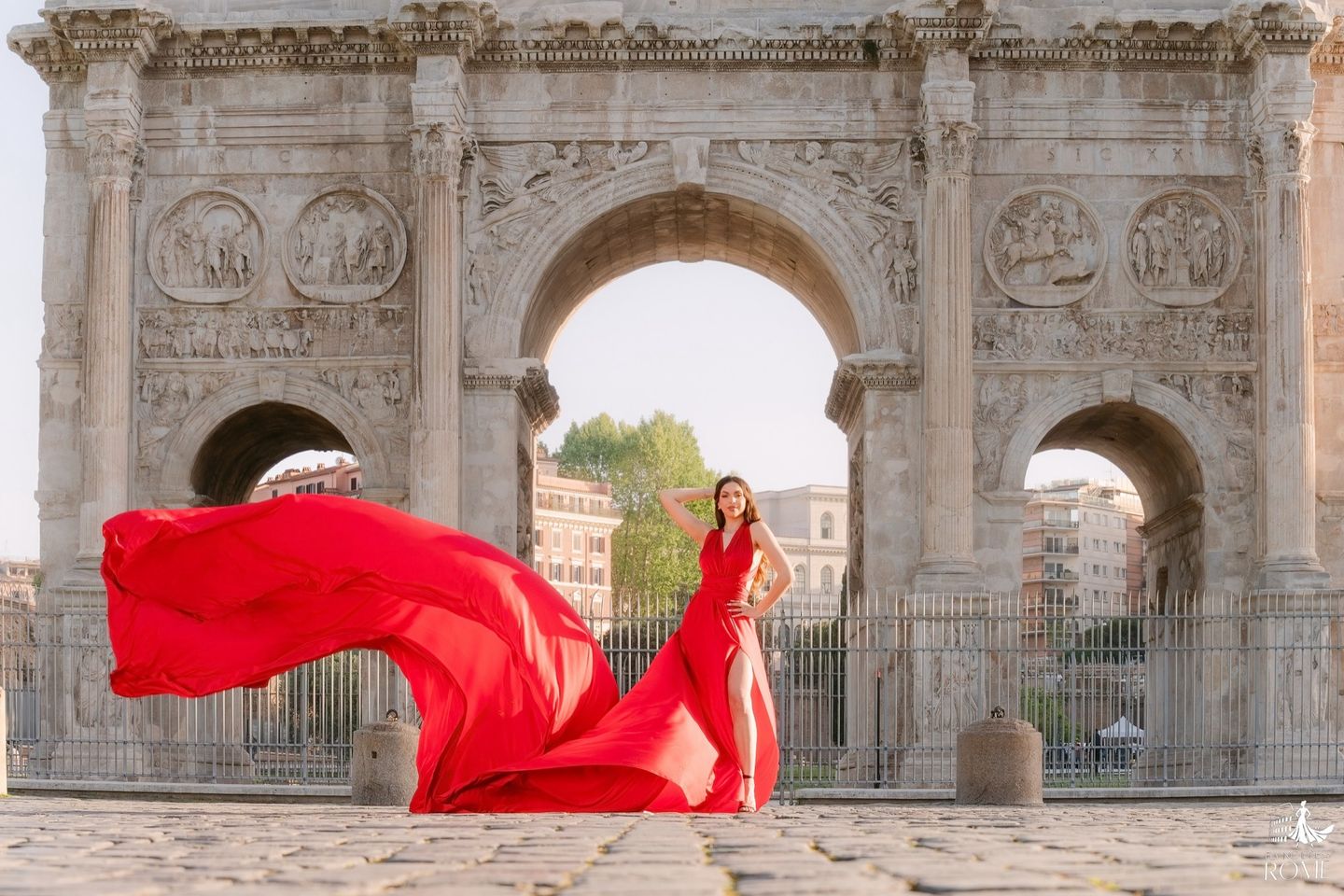
The Diva
An editorial stance: body at three-quarters, one hand on your hip, a level gaze. The train crosses the entire frame sideways and the monument becomes the setting.
You: Hold the position and don't force a smile — a steady look works better here.
We: We step back to take in the whole monument and throw the train across the frame.
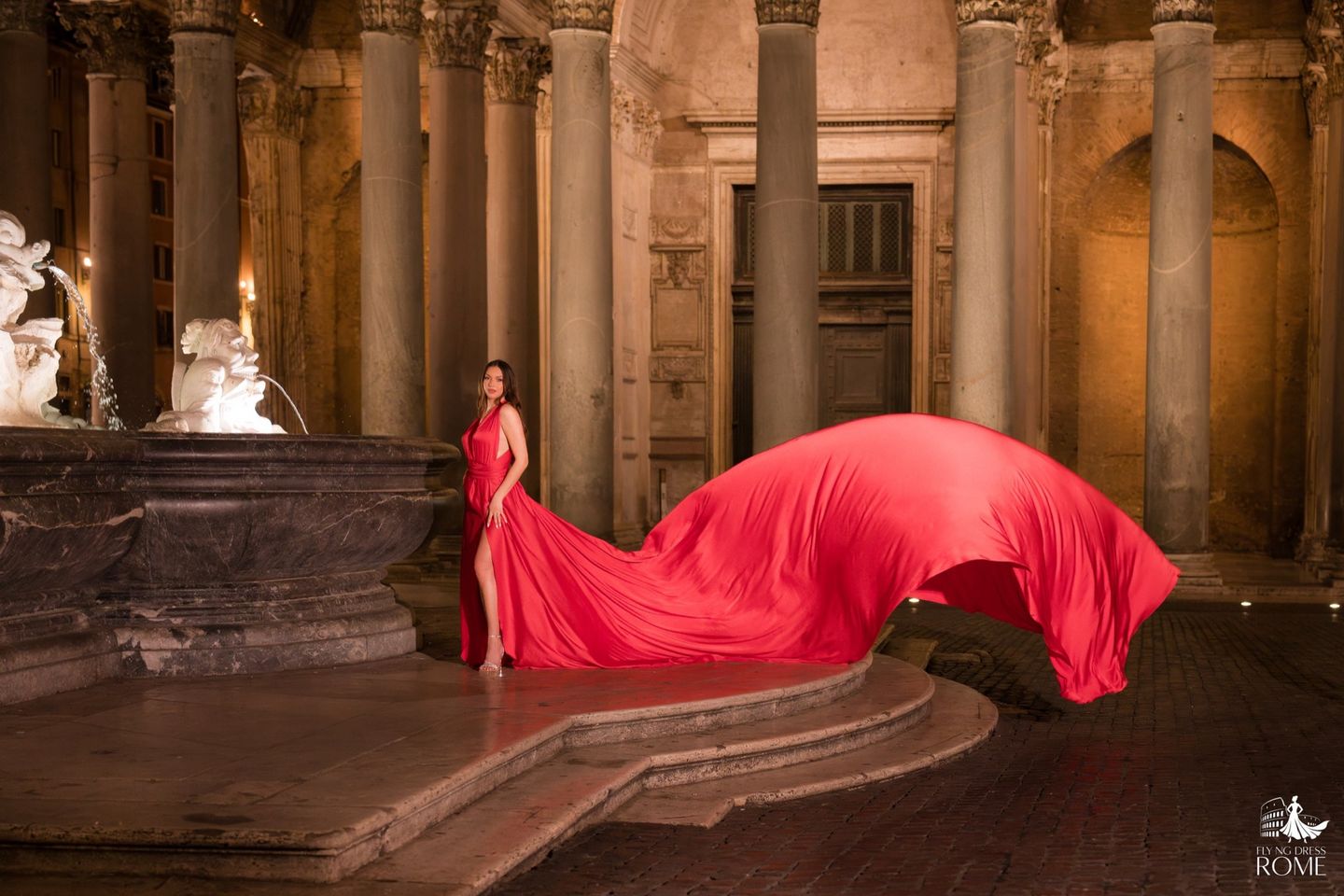
The Stillness
Still, in profile, arms relaxed: you are the only thing not moving in the frame while the train opens out into the dark. It's the counterweight to the moving poses — and often the one that ends up printed.
You: Stop moving, lengthen your neck, breathe out.
We: We handle the fabric — you hold still until we tell you to relax.
Couple session
If you're coming as a couple, these five are added to the solo poses above.
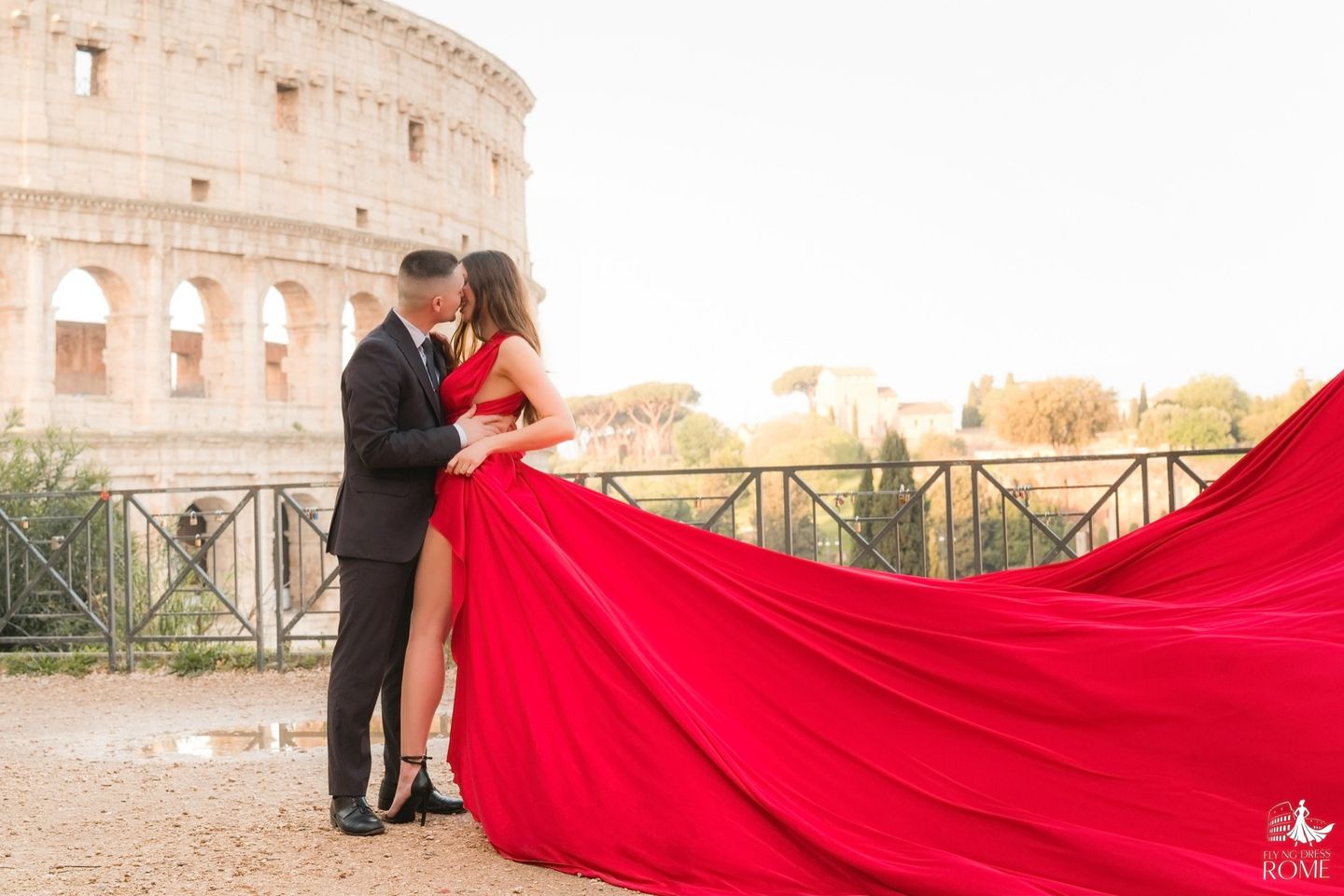
The Embrace
He holds you at the waist, you arch back just slightly, the train is thrown behind you. Genuinely close — not the polite distance of a group photo.
You: Lean into him and keep the arch small.
We: We aim the throw so the fabric opens away from your faces.
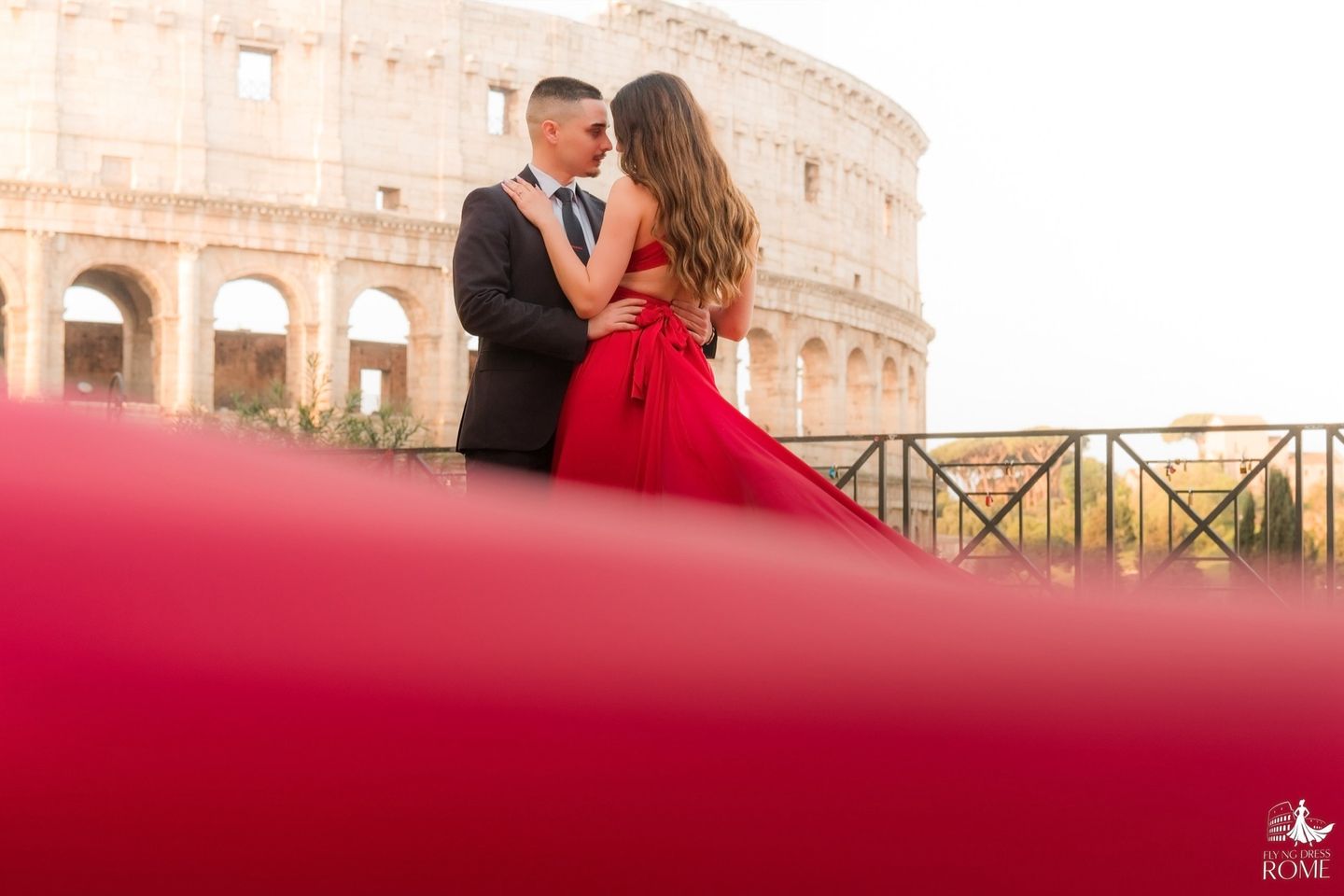
The Tender Moment
Forehead to forehead, time slowing down. The train sweeps in front of the lens and blurs in the foreground: only the two of you stay in focus, everything else is color.
You: Move close and stay there. Don't look at the camera.
We: We sweep the fabric across the lens while we shoot.
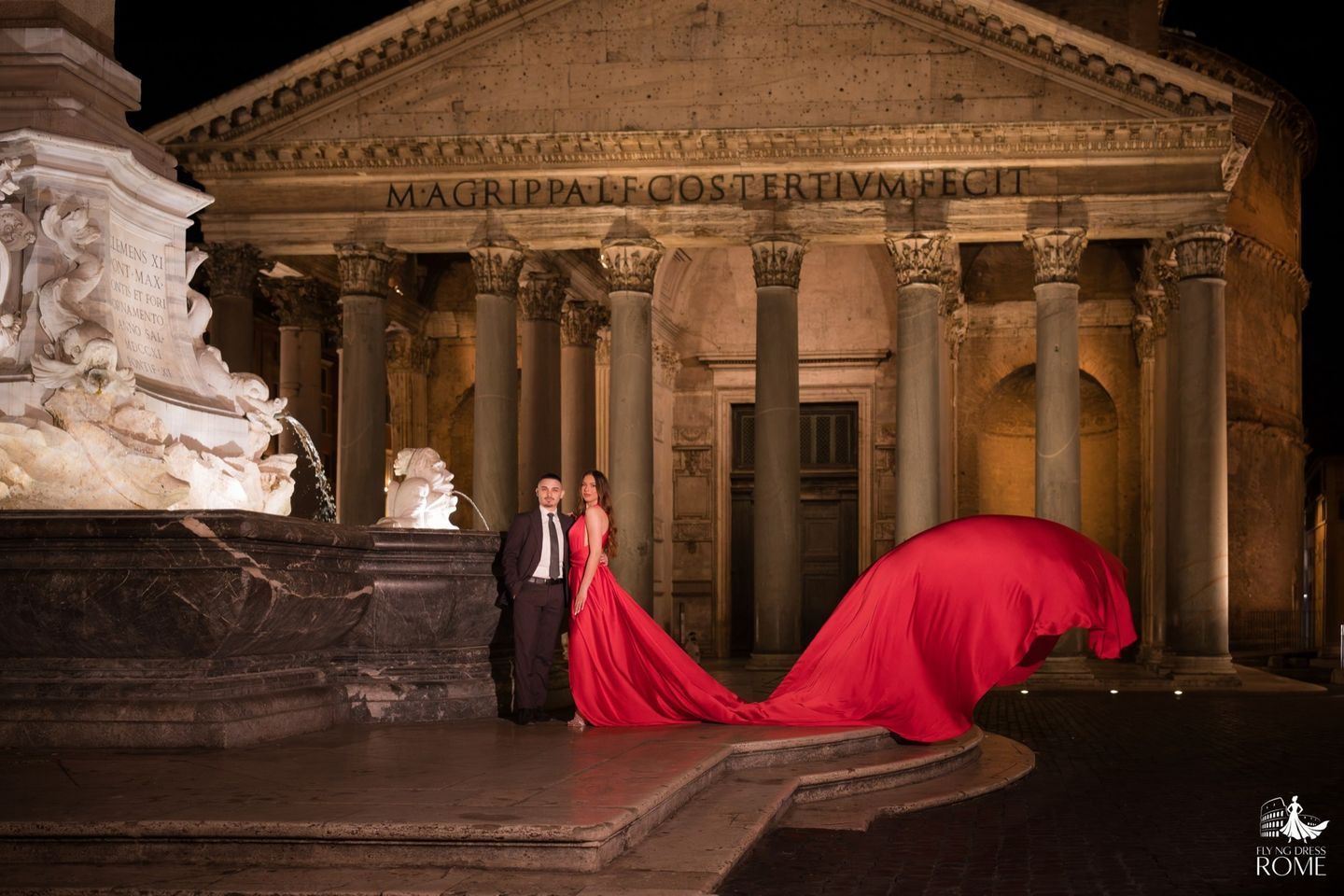
The Classic
Standing side by side, composed, in front of the lit monument. This is the photo that holds up over the years: no acrobatics, just the two of you and Rome behind.
You: Stand close to him, shoulders open, chin slightly toward the camera.
We: We light the two of you and let the monument stay warm behind.
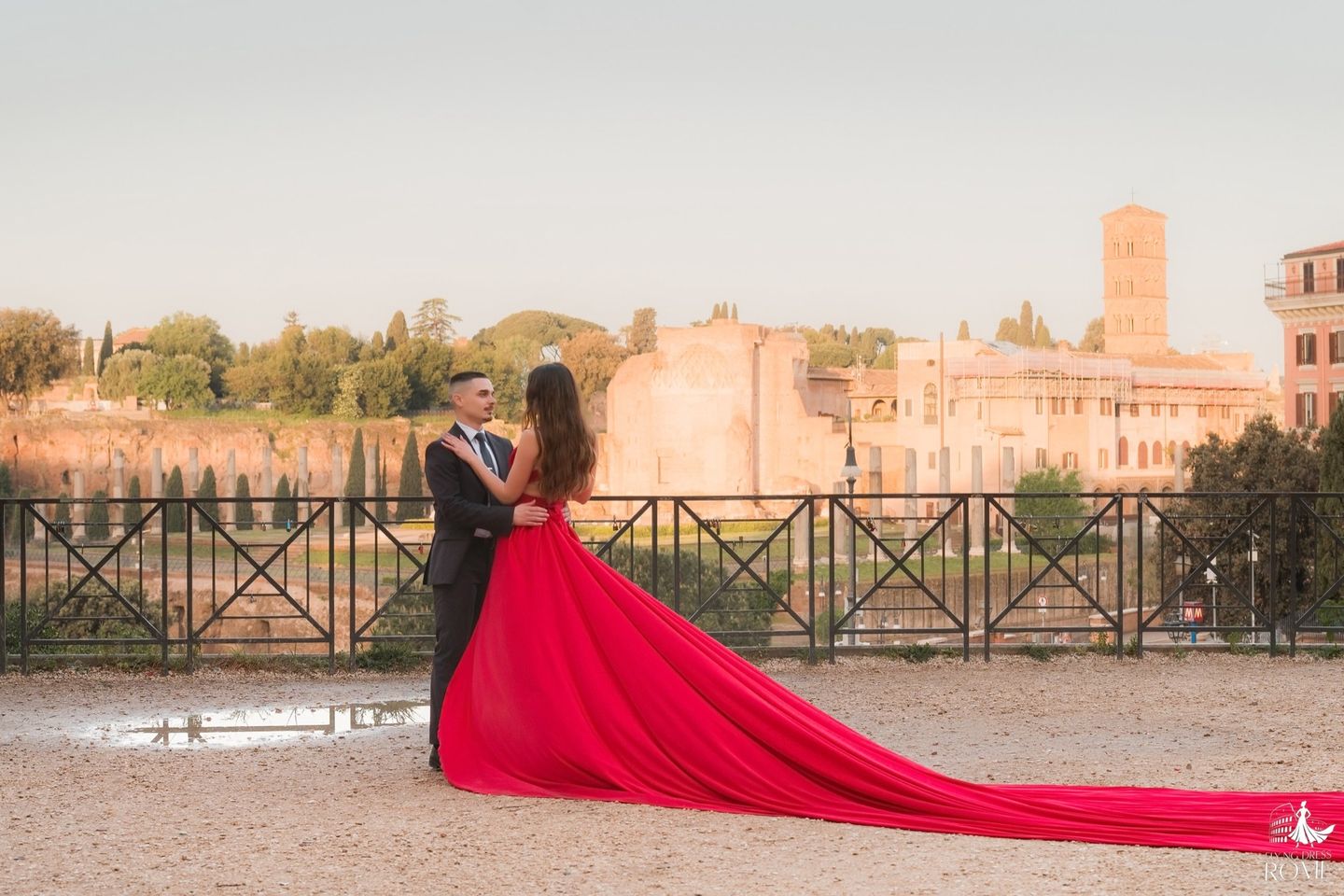
The View
Still, almost embracing, her back to the camera: you look out over the city together while the train lies stretched out on the ground behind you. It's a static pose, and that is exactly why it works.
You: Stay still and look ahead of you, not at the lens.
We: We stretch the train out toward the camera and shoot from a distance.
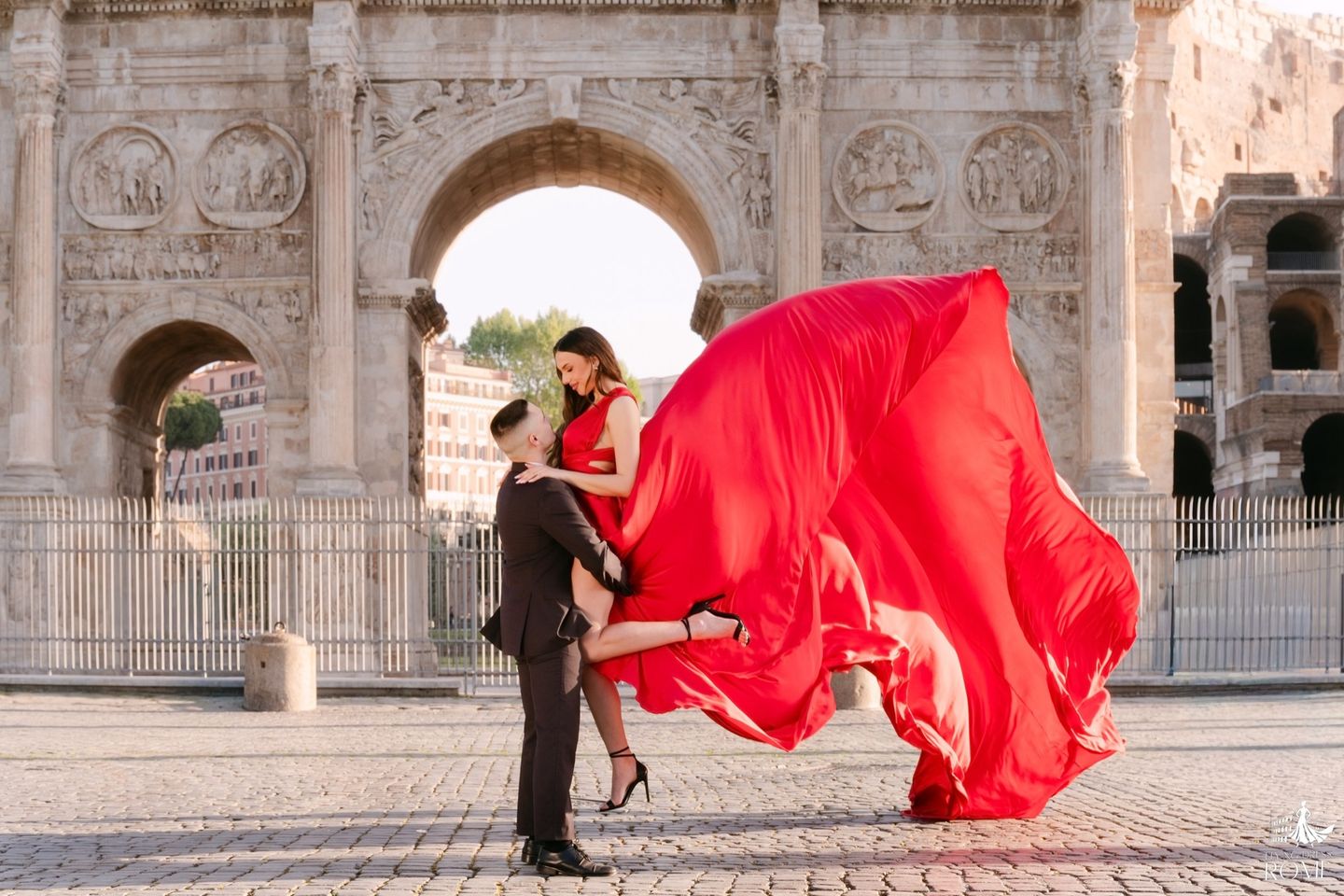
The Dip
He leans you back while holding you. Classic, theatrical, and with a long dress it always works: the train follows the fall and draws a curve.
You: Keep your neck long and let him carry your weight.
We: We show him how to hold you first, then count the movement out loud.
Good to know
Three things worth knowing
-
Why sunrise (and why night)
We shoot at sunrise and, for night sessions, in the dark hours before first light. Those are the only moments when the monuments are empty — and at night they are still lit. It is also about room: five meters of train need a clear square to open out fully.
-
The train is five meters long
When we move between spots, keep it gathered up in your arms. On the ground it picks up dirt and catches on everything.
-
The timing is tight on purpose
Keeping to the schedule is exactly what lets every single session run in full.
Extras
If you want something more
On top of the package you picked, you can add:
-
Your gallery delivered within 24 hours
-
Premium prints, hand-delivered
Ask us in advance or on the day of the shoot and we'll tell you what's possible.
Haven't booked yet?
Send us a message: we'll get back to you with open dates and the location that fits what you have in mind.